Can your storage tank safely operate for longer?
Extend the life of existing storage tanks with engineering evidence.

Extend the life of existing storage tanks with engineering evidence.
Storage tanks are among the most valuable assets in terminals and industrial facilities. Over decades of operation, they can be exposed to corrosion, settlement, changing operating conditions and accidental impacts. These issues can raise concerns about safety, compliance and remaining service life.
The key question is: can the tank still safely perform its intended function?
Every unnecessary repair means additional costs. Not only for the repair itself, but also for planning, inspections, downtime, and lost operational flexibility. Making the right decision often requires more than a visual inspection. It requires engineering evidence.
At Femto Engineering, we combine Finite Element Analysis (FEA), inspection data and engineering standards to assess the structural integrity of existing storage tanks and determine their remaining structural capacity.
Inspection reports frequently identify defects such as dents, corrosion, or geometric deviations. The challenge is determining whether these findings require immediate intervention or whether the tank can continue operating safely.
Rather than relying solely on conservative assumptions, we perform detailed engineering assessments that quantify the remaining structural capacity of the tank. This allows operators to distinguish between acceptable degradation and defects that genuinely require action.
Our expertise includes:
Whether evaluating local shell damage after mechanical impact, assessing remaining strength due to corrosion, or verifying frangible roof performance, we provide clear, technically robust answers that enable sound engineering decisions.
Trusted by our clients for more than 30 years:
When an inspection identifies tank shell deformations that exceed the tolerances of the applicable design standard, a Fitness-for-Service (FFS) assessment can determine whether the tank can continue to operate safely and under what conditions.
Our assessment approach combines inspection data, 3D scanning and advanced Finite Element Analysis (FEA) in accordance with ASME FFS-1.
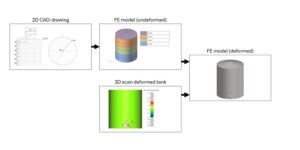 Typically required: 2D/3D as-built drawings, a 3D scan and the latest inspection report.
An FE model of the original tank geometry is developed using the available as-built drawings. The undeformed model is then mapped onto the 3D scan, allowing the measured shell deformations to be incorporated directly into the analysis model.
The resulting model represents the tank in its actual, deformed condition. Relevant operating and environmental loads are then applied, and a series of load cases is analysed. The analysis evaluates critical failure modes including plastic collapse, local failure and buckling.
The results
If the tank does not meet the criteria under current conditions, we can assess reduced filling levels to determine the maximum allowable operating capacity.
The result goes beyond a simple pass-or-fail: you get the engineering evidence needed to decide whether to continue operation, adjust operating conditions, repair or replace the tank.
30+ years of CAE experience, combining advanced structural simulation with practical engineering expertise.
You get:
Discuss your project challenge
Do you need more information or want to discuss your project? Reach out to us anytime and we’ll happily answer your questions.
At Femto Engineering we help companies achieve their innovation ambitions with engineering consultancy, software, and R&D.
We are Siemens DISW Expert Partner for Simcenter Femap, Simcenter 3D, Simcenter Amesim, Simcenter STAR-CCM+, SDC verifier, Altair HyperWorks, Altair SimSolid and Altair PhysicsAI. Get in touch and let us make CAE work for you.
Sign up for our newsletter to get free resources, news and updates monthly in your inbox. Share in our expertise!