

1D system simulation: How to choose the right tool for your engineering project
Discover what 1D system simulation is, how it supports engineering across industries, and which criteria matter when choosing the right software.

Discover what 1D system simulation is, how it supports engineering across industries, and which criteria matter when choosing the right software.

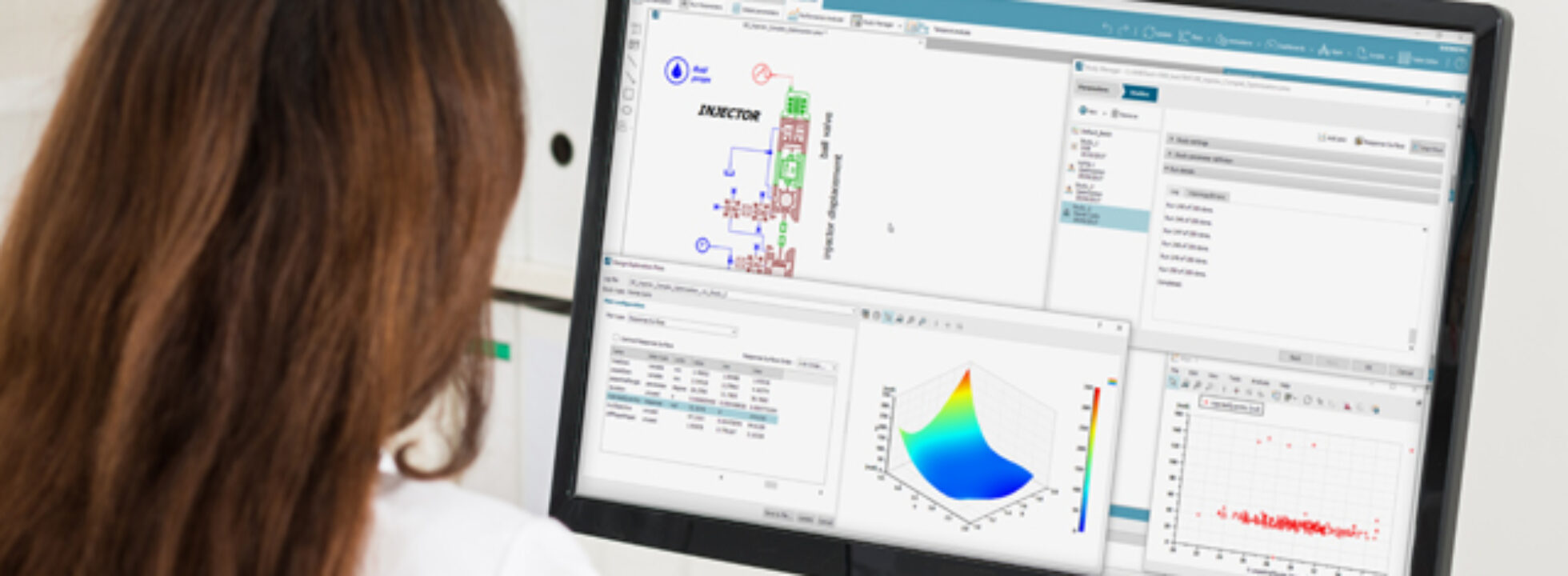
Developing complex engineering systems means balancing performance, efficiency, reliability and cost, often under tight deadlines. Whether designing a thermal management system, optimising hydraulic circuits or developing an electrified powertrain, engineers need to understand how different components interact before committing to physical prototypes.
This is where 1D system simulation becomes valuable. It allows engineers to model the behaviour of an entire system using mathematical representations of its components and the physical processes connecting them. Rather than focusing on detailed three-dimensional geometry, 1D simulation concentrates on how energy, mass and signals flow through a system over time.
By simulating these interactions, engineering teams can predict performance, investigate operating conditions and evaluate design alternatives earlier in development. This helps identify potential issues, reduce reliance on costly physical testing and make better-informed design decisions.
Unlike 3D computational fluid dynamics (CFD) or finite element analysis (FEA), which typically investigate detailed local phenomena, 1D simulation focuses on overall system behaviour. It also complements physical testing: simulation explores a wide range of scenarios, while experiments help validate models and confirm real-world performance.
From concept development and architecture selection to detailed design and system optimisation, 1D simulation can support decisions throughout the product lifecycle. Its value is particularly significant when component interactions determine overall performance.
For a deeper technical introduction, read our article on 1D system simulation. You can also explore the benefits of simulation in product development.
Planning to optimize a design? Let us help you certify it with confidence.
System simulation is used wherever interconnected components influence the behaviour of a larger engineering system. Its strength lies in capturing these interactions across different physical domains.
In automotive and mobility engineering, engineers can model powertrains, battery thermal management, braking systems and vehicle thermal networks. Simulation helps assess energy consumption, component sizing and performance under different driving conditions, including the impact of electrification.
In aerospace and defence, system models can represent fuel supply, hydraulic actuation, thermal management and environmental control systems. Engineers can investigate transient behaviour, operating limits and the consequences of changing operating conditions.
 In industrial machinery and manufacturing, hydraulic and pneumatic circuits, fluid networks and electromechanical systems can be analysed to improve response times, efficiency and reliability. Simulation can also help diagnose pressure losses, unstable behaviour or inadequate component sizing.
Energy and process industries benefit from modelling heating and cooling circuits, heat exchangers, refrigeration systems and energy conversion processes. Engineers can evaluate energy efficiency, control strategies and performance across different loads.
The approach also supports marine, rail and building technology applications, from propulsion and onboard cooling to HVAC systems and energy distribution.
Across these sectors, common applications include predicting system performance, sizing components, evaluating control strategies, analysing transient events and exploring design alternatives before building prototypes.
The appropriate model depends on the question being investigated. Engineers may use simplified representations during early architecture studies, then increase model detail as design requirements become clearer. The objective is not to reproduce every physical detail, but to capture the behaviour needed to make a reliable engineering decision.
There is no universally best 1D system simulation tool. The right choice depends on your engineering objectives, the systems you need to model and how simulation fits into your existing development process.
Consider the following criteria when evaluating software.
1. Application fit and physical domains
Start by identifying the systems you need to simulate. Do your projects involve fluid mechanics, thermal processes, mechanical motion, electrical networks or a combination of these? Check whether the software supports the required physical domains and provides appropriate components, models and libraries. Multi-domain capability is particularly important when interactions between disciplines determine overall system performance.
2. Model fidelity and computational performance
The model must represent the physics relevant to your engineering question without unnecessary complexity. Assess the available modelling approaches, numerical solvers and options for adjusting model fidelity. Consider whether the tool can handle fast transients, stiff systems, long-duration simulations and large models within acceptable runtimes.
3. Integration with your existing workflow
Simulation software should work with your broader engineering environment. Investigate support for CAD, 3D simulation, control development, test data and other relevant tools. Compatibility with standards such as Functional Mock-up Interface (FMI), where supported, can also facilitate model exchange and co-simulation.
4. Scalability and collaboration
A tool suitable for a single component study may not be sufficient for system-level development. Consider whether models can be reused, expanded and shared across teams, projects and product variants. Model management, automation and integration into optimisation or virtual validation workflows may become increasingly important as simulation matures within your organisation.
5. Usability and required expertise
Evaluate the learning curve, documentation, training resources and support available. A graphical modelling environment can help engineers build models efficiently, while advanced users may need scripting, custom component development or access to underlying equations. Consider the expertise already available within your team and the training investment required.
6. Total cost and long-term value
Look beyond the initial licence price. Include maintenance, training, implementation, model development and ongoing support. Consultancy may accelerate adoption, help validate models and address specialist engineering challenges, particularly when internal resources are limited.
Ultimately, compare tools against a defined set of engineering requirements. A structured evaluation using a representative use case is more informative than selecting software based on brand recognition or feature lists alone.
Planning to optimize a design? Let us help you certify it with confidence.
Choosing the right 1D system simulation software starts with understanding the engineering problem, not selecting a product. Define the system you need to model, identify the physical domains involved and establish measurable performance targets. Then assess candidate tools against model fidelity, computational performance, integration, scalability, usability and total cost.
Where possible, validate the selection through a representative use case. This provides practical evidence of how well the software supports your engineering workflow and whether it can deliver useful results within the available time and resources.
However, successful simulation involves more than software alone. Building appropriate models, selecting assumptions, validating results and translating findings into design decisions all require the right combination of tools and engineering expertise.
With expertise in simulation software and practical engineering consultancy, Femto Engineering helps engineering teams identify suitable modelling approaches, implement simulation workflows and address complex system-level challenges.
Whether you are evaluating Simcenter Amesim, establishing a new simulation capability or looking to improve an existing model, we can help you determine the most effective way forward.
Have a system simulation challenge to solve? Contact our team to discuss your project, engineering objectives and how we can help.
Do you need more information or want to discuss your project? Reach out to us anytime and we’ll happily answer your questions.
At Femto Engineering we help companies achieve their innovation ambitions with engineering consultancy, software, and R&D.
We are Siemens DISW Expert Partner for Simcenter Femap, Simcenter 3D, Simcenter Amesim, Simcenter STAR-CCM+, SDC verifier, Altair HyperWorks, Altair SimSolid and Altair PhysicsAI. Get in touch and let us make CAE work for you.
Sign up for our newsletter to get free resources, news and updates monthly in your inbox. Share in our expertise!