

How Alklima ensures reliable hot water with optimal energy efficiency using simulation
Have you ever stepped into a hotel shower and wondered whether the hot water was being generated sustainably and as efficiently as possible?

Have you ever stepped into a hotel shower and wondered whether the hot water was being generated sustainably and as efficiently as possible?
For building owners and system designers, this question is becoming increasingly important. Domestic hot water systems are not easy to decarbonise because they require relatively high water temperatures. A CO₂ heat pump is one of the sustainable solutions available to meet this challenge.
These heat pumps achieve their highest performance when the temperature difference within the storage tank is large. This requires careful optimisation of the hot water storage system, taking into account both hot water demand and heat generation, while ensuring that user comfort remains the top priority. Complaints about cold or lukewarm shower water are simply not acceptable.
The challenge of designing an optimally performing storage tank is therefore essential to achieving a sustainable and reliable hot water system.
To better understand these challenges, Alklima and Femto Engineering used computational fluid dynamics (CFD) simulation to investigate how a CO₂ heat pump buffer system behaves during realistic daily usage.
“Working with Femto Engineering was a very positive experience. Their team not only demonstrated strong CFD simulation expertise but also developed a deep understanding of the technical and physical challenges behind our project. Their proactive approach and valuable insights helped us optimize the design and contributed significantly to a successful end result.”
– Martijn van Leerdam, Coördinator Product Management, Alklima –
Reliable hot water is something most people simply expect, whether in hotels, apartment buildings or sports facilities. Behind this comfort lies a complex system. As buildings adopt more sustainable technologies such as CO₂ heat pumps, ensuring sufficient hot water during peak demand is essential. At the same time, producing this hot water with maximum efficiency becomes an increasingly growing engineering challenge.
Alklima, the exclusive Dutch distributor of Mitsubishi Electric climate solutions, continuously works on innovative and sustainable heating technologies. To better understand the behavior of one of its hot water systems, Alklima partnered with Femto Engineering to investigate the performance of a dual-tank storage system while maintaining user comfort.
The key question was simple: How the system maintains the largest possible temperature differential within the storage tank during realistic operating conditions while continuing to meet domestic hot water demand.
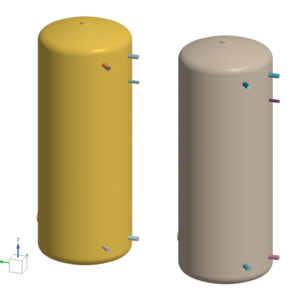 Photo 1. CAD of the dual-buffer tank system
The system consisted of two connected water tanks that act as a thermal buffer for a CO₂ heat pump installation. At first glance, storing hot water may seem straightforward. In reality, however, water inside these tanks is constantly moving and changing temperature.
Demand also changes throughout the day. Morning showers, cleaning activities and periods of low usage all influence how heat is distributed inside the system.
Another important aspect is hot water recirculation. In many buildings, a small continuous flow ensures that hot water is immediately available at showers and taps. While this improves comfort, it can also disturb the natural layering of hot and colder water inside the tanks.
These effects are difficult to predict with simple engineering calculations. Building a physical prototype would also require significant time and cost. This is where CFD simulation can provide value.
By creating a virtual model of the system, engineers can understand how water flows, how temperatures change and how the control system behaves long before the system is installed.
For manufacturers, system integrators and HVAC engineers, this can significantly reduce engineering risks and prevent costly redesigns later in the project.
Is your system performing as expected? See what simulation can reveal before you build.
 The real question was not whether the system could produce hot water, it was whether it could continue delivering enough hot water when demand suddenly increased.
Answering this required more than looking at temperatures and flow patterns alone. The team also needed to understand how the heat pump would react as conditions changed throughout the day.
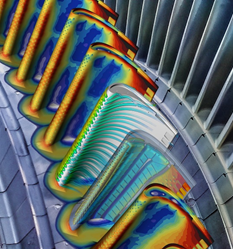
Using Simcenter STAR-CCM+, Femto Engineering could model the complete behaviour of the system, including the automatic controls that switch the heat pump on and off. This created a realistic virtual representation of daily operation and helped reveal potential issues long before the system was built.
Femto Engineering created a virtual model of the two storage tanks and part of the connecting pipework. To keep the model efficient, the heat exchanger itself was simplified.
Using realistic hot water usage data from Alklima, the team simulated a full 24-hour operating cycle, including a second scenario with continuous hot water recirculation.
The simulations showed how temperatures change throughout the day and how water naturally moves inside the tanks. Hot water is lighter and rises, while colder water sinks. This creates natural layers inside the tanks, which strongly affects how much usable hot water remains available.
Different mesh sizes and settings were also tested to ensure reliable results. This virtual approach allowed the team to better understand system behaviour and identify improvements before physical testing or installation.
The simulations showed that the overall control strategy worked as intended. However, they also revealed an important issue: During certain periods of the day, the outlet temperature dropped below the desired level.
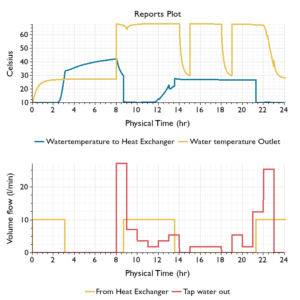 Figure 1. Simulation results without hot water recirculation show that the outlet temperature remains above 30°C for most of the day but drops during the final hour, revealing an opportunity to optimize the system design and control strategy.
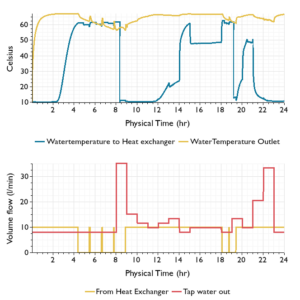 Figure 2. Simulation results with continuous hot water recirculation show that the outlet temperature remains above 50°C throughout the day, although the heat exchanger must operate for longer periods to maintain this performance.
The analysis showed that the location of temperature sensors and the selected control settings strongly influenced the amount of available hot water.
Based on these findings, several improvement options were identified. One possible improvement was to move a temperature sensor lower inside one of the tanks, effectively increasing the usable hot water buffer. Other options included adjusting the control settings so that reheating starts earlier.
The simulations showed that adding an instant hot water flow changed how the system operated. Instead of the tank temperatures being the main driver, the heat exchanger protection settings had the biggest impact on the system behaviour.
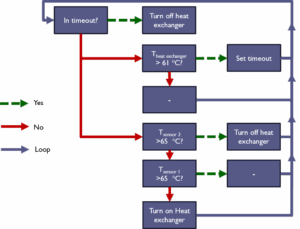
Figure 3. Control logic implemented in Simcenter STAR-CCM+ automatically switches the heat exchanger on or off based on temperature sensor readings, accurately replicating the system’s real operating behavior over a 24-hour cycle.
For Alklima, the project was not simply about validating a design. It was about achieving optimum efficiency while maintaining the level of comfort expected by end users.
By using Simcenter STAR-CCM+, Femto Engineering could virtually test the system before it was built. The simulations provided insights into temperature behavior, control strategies and operating scenarios that would have been difficult to obtain through traditional calculations alone.
This enabled potential improvements to be identified early, reducing engineering risks and supporting better design decisions.
For manufacturers, system integrators and HVAC engineers facing similar challenges, CFD simulation offers a powerful way to understand system behavior, optimize designs and reduce costly redesigns later in the project.
Author: Martijn van Dijk
CFD Simulation Engineer, Femto Engineering
Is your system performing as expected? See what simulation can reveal before you build.
Do you need more information or want to discuss your project? Reach out to us anytime and we’ll happily answer your questions.
At Femto Engineering we help companies achieve their innovation ambitions with engineering consultancy, software, and R&D.
We are Siemens DISW Expert Partner for Simcenter Femap, Simcenter 3D, Simcenter Amesim, Simcenter STAR-CCM+, SDC verifier, Altair HyperWorks, Altair SimSolid and Altair PhysicsAI. Get in touch and let us make CAE work for you.
Sign up for our newsletter to get free resources, news and updates monthly in your inbox. Share in our expertise!